Something interesting is happening to the humble Google search.
It’s getting longer.
New analysis of Google Ads search-term data through August 2026 suggests people are moving away from short, traditional keyword searches and increasingly describing what they actually want.
Between January 2025 and August 2026, one-to-two-word searches fell from 42% to 24% of impressions in the dataset.
Three-to-four-word searches went the other way, increasing from 33% to 48%.
But it’s the conversion data that caught my attention.
Five-to-six-word searches increased their share of conversions from 3% to 9%, while searches containing seven or more words increased from 1% to 4%.
I think we’re watching search behaviour change.
We’ve spent years teaching people to speak Google
Think about how we traditionally searched.
“accountant Brisbane”
“plumber Newcastle”
“business insurance Sydney”
We reduced what we wanted to a couple of keywords because that’s how we learned Google worked.
Conversational tools have changed that behaviour.
People are becoming comfortable explaining the problem instead:
“accountant in Brisbane who understands small construction businesses”
“emergency plumber available Sunday near Newcastle”
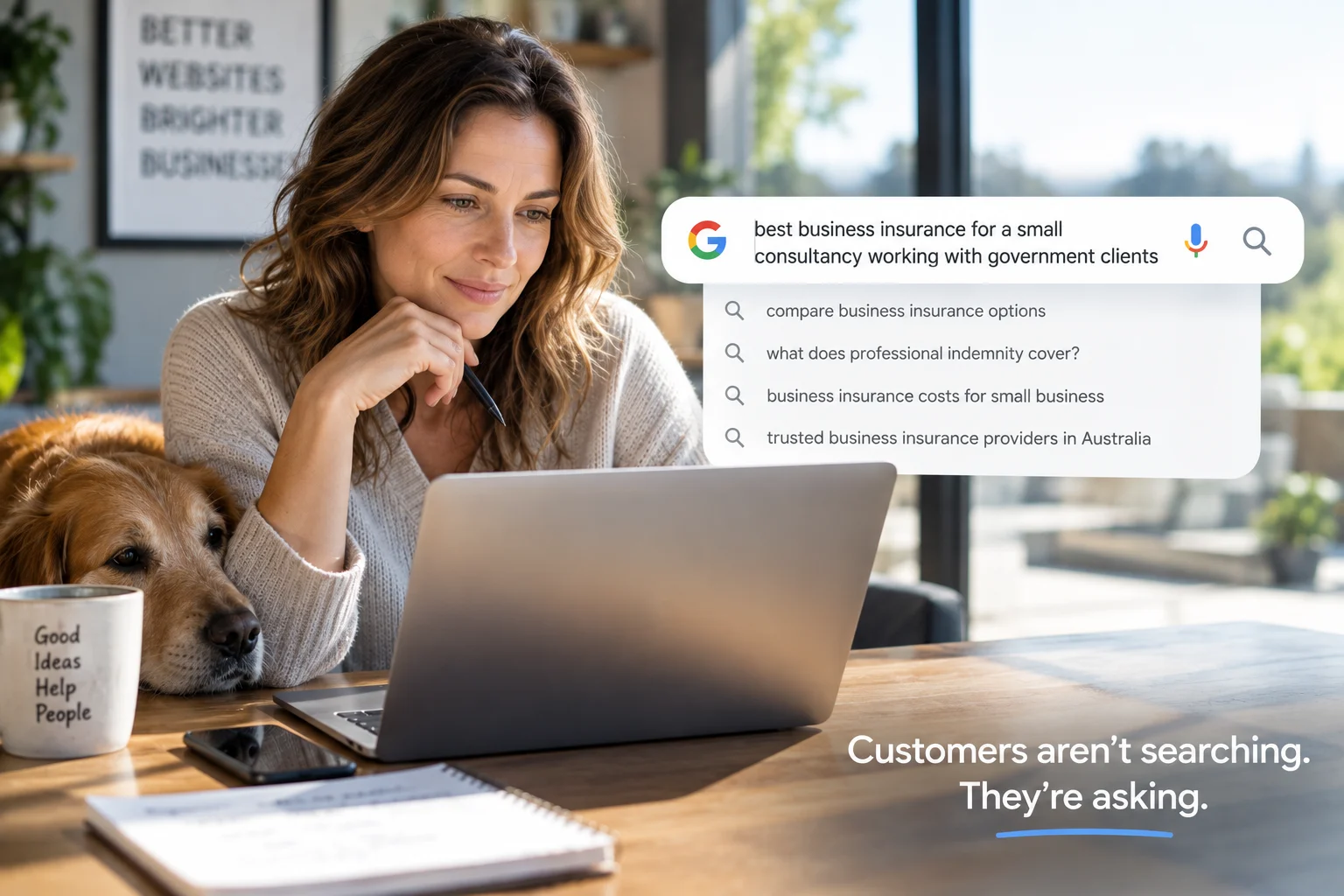
“business insurance for a small consultancy working with government clients”
That’s considerably more information about what the customer actually wants.
And for SMEs, I think that’s an opportunity.
Stop obsessing over individual keywords
I’m certainly not suggesting keyword research has suddenly become irrelevant.
But understanding customer intent is becoming considerably more important than squeezing another exact keyword onto a page.
If somebody provides Google with their location, problem, budget, circumstances and desired outcome in a single search, your website needs to demonstrate that you genuinely solve that particular problem.
- That affects SEO.
- It affects Google Ads.
- It affects landing pages.
- And it affects the content businesses publish.
Generic pages written around broad keywords are competing with increasingly specific questions.
Listen to how your customers actually speak
If I were reviewing an SME’s digital marketing today, I’d spend more time looking at the language customers use.
- Search-term reports.
- Search Console queries.
- Emails.
- Sales enquiries.
- Questions asked over the telephone.
- Customer reviews.
Those are often better sources of marketing language than a keyword tool.
Because they tell us how real customers describe their problems when nobody from marketing is putting words in their mouths.
I’ve said for years that good digital marketing begins with understanding the customer.
Search becoming more conversational doesn’t change that principle.
It reinforces it.
The businesses that benefit won’t necessarily be those producing the most content or targeting the most keywords.
They’ll be the ones providing the clearest answer when a potential customer explains:
“This is my problem. Can you help me?”
References
Search Engine Land, 11 September 2026. Google Ads data shows query length shift post-AI Mode. https://searchengineland.com/google-ads-data-shows-query-length-shift-post-ai-mode-458162
Google Ads Help. About the search terms report. https://support.google.com/google-ads/answer/2472708
Google Search Central. Creating helpful, reliable, people-first content. https://developers.google.com/search/docs/fundamentals/creating-helpful-content