If you’re an SME spending money on Google Ads, I’d suggest doing something fairly simple this week.
Log into your account.
Not because Google Ads has suddenly stopped working.
Because Google has begun automatically changing some existing Search campaigns.
From 1 September, Google started progressively upgrading Search campaigns using campaign-level Broad Match or standalone Automatically Created Assets into its newer AI Max framework.
The rollout continues throughout September.
For businesses actively managing their advertising, this shouldn’t come as a surprise.
But I’m fairly certain there are thousands of SME Google Ads accounts that haven’t been properly inspected for months.
- The campaign is running.
- The credit card is being charged.
- Reports arrive occasionally.
- Enquiries seem to be coming in.
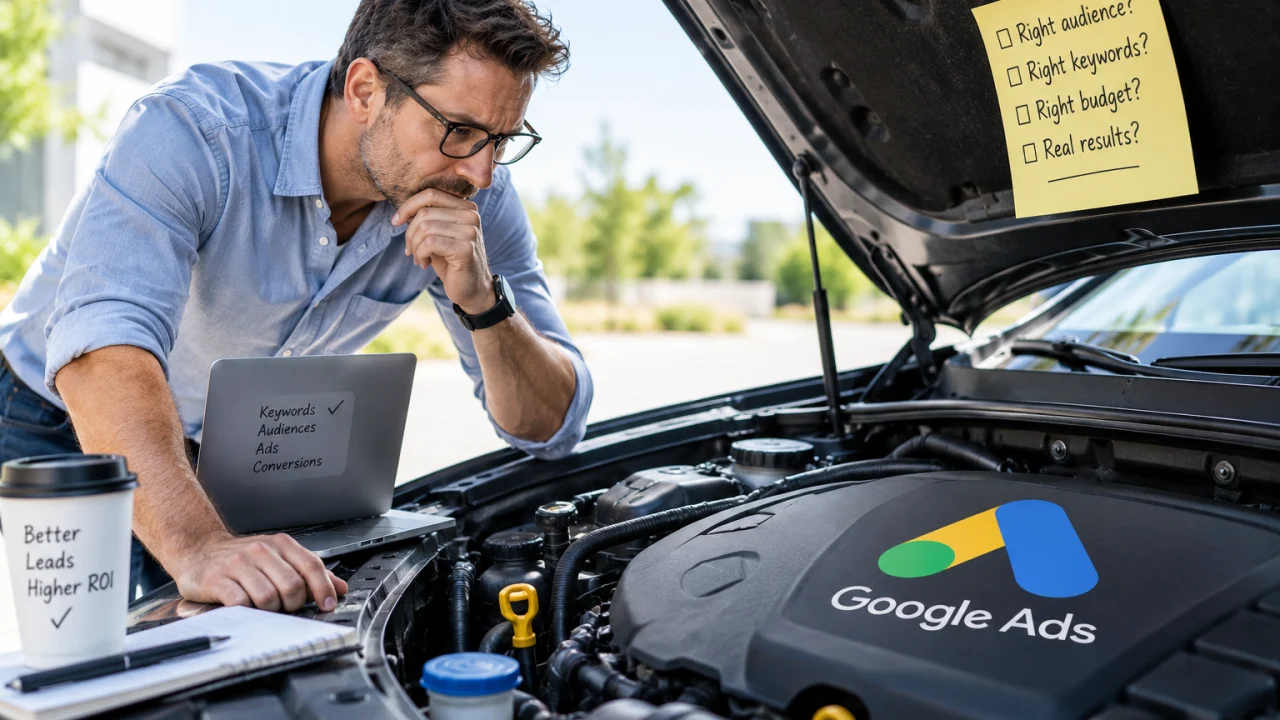
So nobody looks too closely under the bonnet.
That’s the part of this development that interests me.
Google Ads is becoming increasingly autonomous
AI Max gives Google’s systems considerably more responsibility for determining which searches represent potential customers and, depending upon the settings being used, how advertising content is created and which website pages customers are directed towards.
Google says advertisers using the full AI Max feature suite are seeing an average 7% increase in conversions or conversion value at a similar cost per acquisition or return on advertising spend compared with using search-term matching alone.
That’s Google’s data, and I’m not dismissing it.
Automation can absolutely improve advertising performance.
But I’ve always believed there’s an important difference between automating a campaign and abandoning one.
Someone still needs to watch where the money goes
If I were running an SME Google Ads account affected by this month’s migration, I wouldn’t immediately switch everything off.
- I’d establish what changed.
- Then I’d look at the search terms generating clicks.
- I’d check which landing pages Google is using.
- I’d review the advertising copy.
- I’d check conversion tracking.
And most importantly, I’d look beyond Google’s definition of a conversion and ask whether those conversions are producing genuine enquiries and customers.
Because Google can optimise incredibly efficiently towards the objective we give it.
The problem arises when we’ve given it the wrong objective.
- A form submission isn’t necessarily a qualified lead.
- A phone call isn’t necessarily a sale.
- And a cheaper conversion isn’t necessarily a better customer.
That’s where human judgement still matters.
This isn’t really an article about AI
It’s about accountability.
Google Ads has gradually moved from a platform where advertisers controlled individual keywords, bids and advertisements towards one where algorithms increasingly make those decisions.
That direction isn’t going to reverse.
For SMEs, I don’t think the answer is resisting every piece of automation.
It’s making sure somebody remains accountable for the commercial result.
So if your business has Google Ads quietly running in the background, I’d add one question to this week’s agenda:
When did somebody last properly look under the bonnet?
Because Google may already be making changes while you’re reading this.
References
Google Ads Developers Blog. AI Max for Search campaigns: 2026 upgrade timeline. https://ads-developers.googleblog.com/2026/
Google. Dynamic Search Ads are upgrading to AI Max. https://blog.google/products/ads-commerce/dsa-upgrade-to-ai-max-2026/
Google Business. Dynamic Search Ads are upgrading to AI Max. https://business.google.com/us/accelerate/announcements/dsa-upgrade-to-ai-max-2026/