
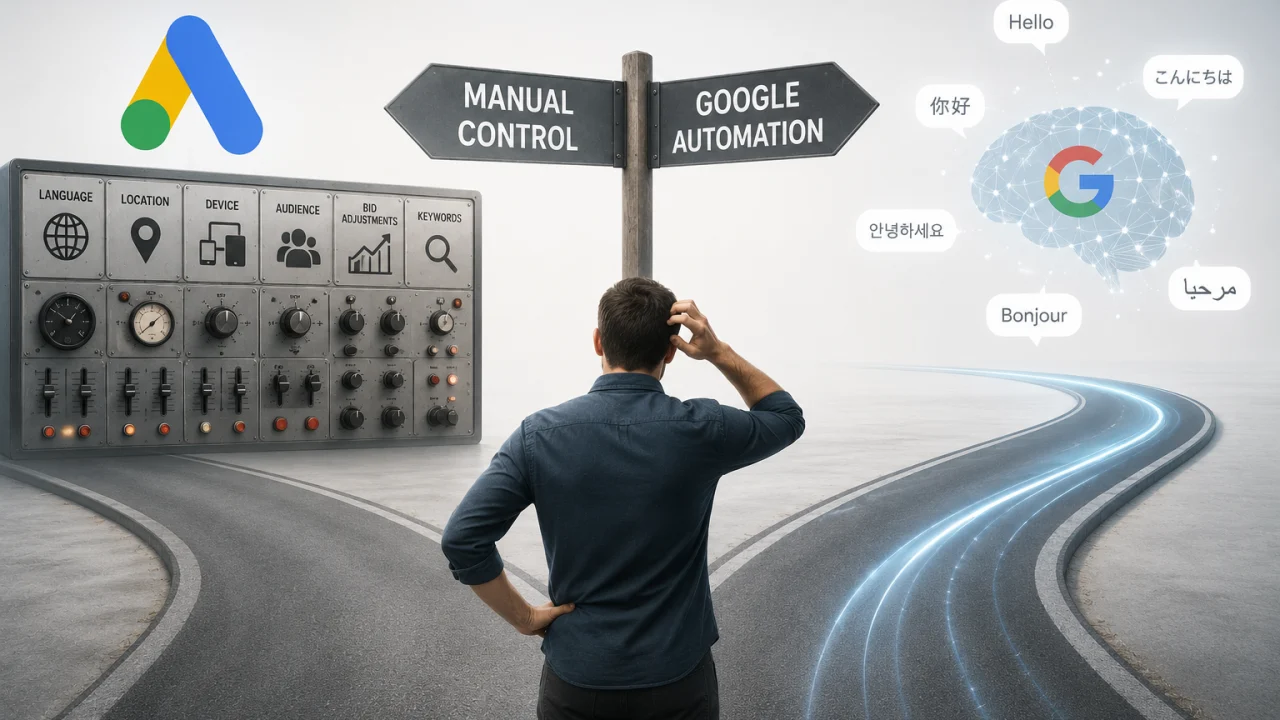
Google has confirmed that from September 2026, language targeting will change for Search campaigns and the Search portion of Performance Max.
Advertisers will no longer control language targeting in quite the same way.
Instead, Google will rely more heavily on the language used in the ad itself, together with signals about the languages a user understands.
On the surface, this sounds like a relatively minor technical adjustment.
I don’t think it is.
For me, this is another example of Google steadily taking more control away from advertisers and placing it inside its automated systems.
We have already seen this happen with bidding, audience targeting, keyword matching and creative assets.
Now language targeting is moving in the same direction.
For larger advertisers, this may simplify campaign management.
For SMEs, I think it deserves closer scrutiny.
If you operate in a multilingual market, or serve customers from different cultural backgrounds, language can be commercially important.
A business targeting English-speaking customers in Australia may also attract users who search in Mandarin, Vietnamese, Arabic or another language.
That can be useful.
But it can also create wasted spend if the ad, landing page and service experience are not relevant to that user.
The key point is that automation does not remove the need for strategy.
It increases it.
If Google is deciding more of the targeting, then I believe advertisers need to become much stricter about everything they still control.
- The wording of the advertisement.
- The landing page.
- Location targeting.
- Conversion tracking.
- Negative keywords.
- The offer itself.
And most importantly, whether the leads generated are commercially valuable.
I have never believed that more automation automatically means better marketing.
Automation can improve efficiency.
But efficiency without oversight can simply help you waste money faster.
For SMEs running Google Ads, I think this change is another reminder to stop treating campaign settings as something you configure once and forget.
Google’s systems are becoming more autonomous.
That makes ongoing monitoring more important, not less.
The question I would be asking is simple:
If Google is making more of the targeting decisions for me, am I measuring the quality of the results closely enough?
References
Google Ads Help. About language targeting. https://support.google.com/google-ads/answer/1722078
Search Engine Journal, 13 August 2026. Google Is Removing Language Targeting From Search Campaigns. https://www.searchenginejournal.com/google-is-removing-language-targeting-from-search-campaigns/585592/
Search Engine Land, 13 August 2026. Google Ads is removing language targeting from Search campaigns. https://searchengineland.com/google-ads-is-removing-language-targeting-from-search-campaigns-484831